
Key Takeaways
- Ownership Tracking: A cap table is your company’s official record of who owns what, including founders, employees, and investors.
- Funding Preparation: You need an accurate cap table to pass due diligence when raising money from Angel Investors or Venture Capitalists.
- Dilution Management: The table helps you visualize how new investments reduce your ownership percentage so you can plan for the future.
- Regulatory Compliance: Accurate records are required for tax valuations, such as 409A in the US and Merchant Banker valuations in India.
- Team Incentives: You use the cap table to manage your employee stock option pool and track how shares vest over time.
You start your business with 100% ownership, but you share that ownership with others as you grow to gain capital and talent. You must track exactly who owns which portion of your company, and understanding what is a cap table is the first step in that process.
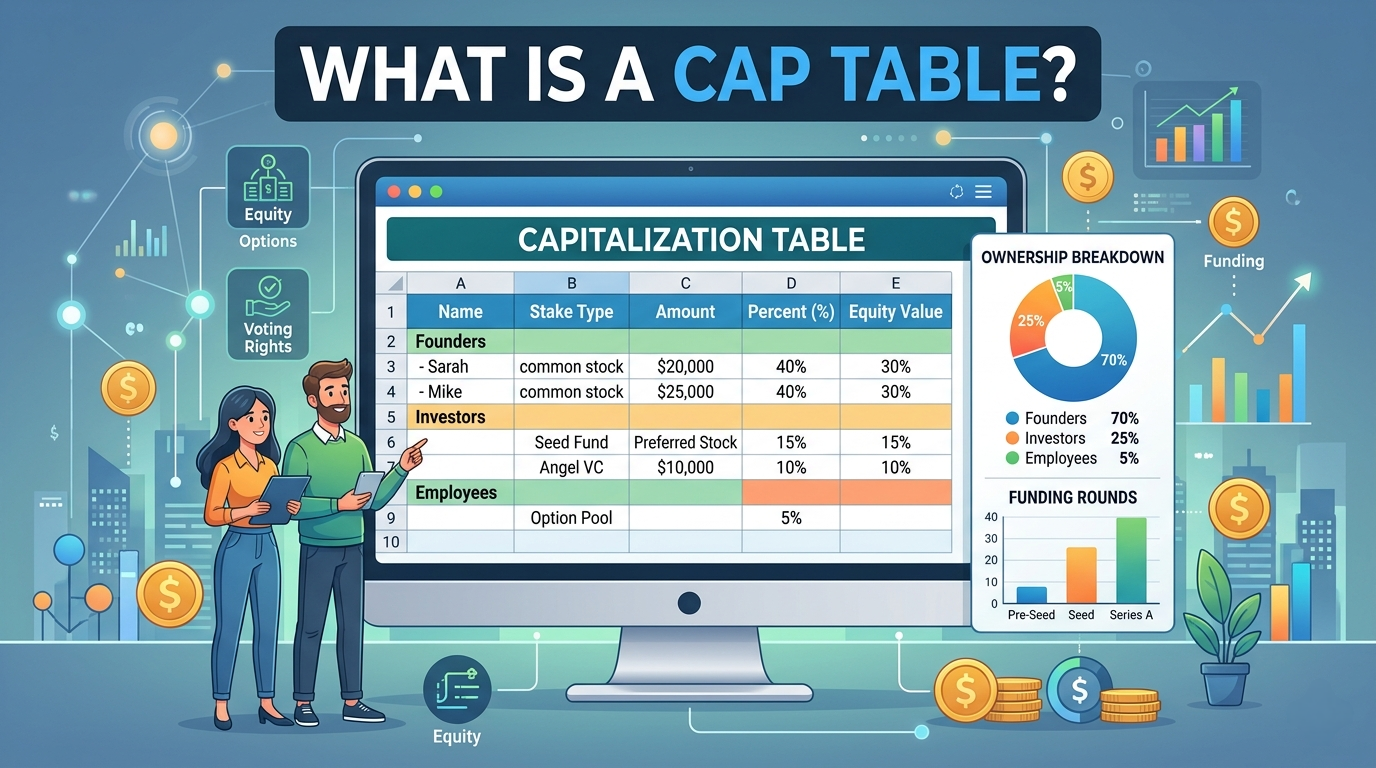
A cap table is a specialized ledger that tracks the equity ownership of a company. It provides a clear list of every shareholder, the number of shares they hold, and their percentage of ownership.
Maintaining an accurate record is essential for your startup’s survival and growth. It is estimated that roughly 9 out of 10 (90%) startups and early-stage businesses managing their cap tables on spreadsheets have errors in their calculations.
This guide explains what a cap table is, how it functions in different business contexts, and why you must keep precise records to ensure your company succeeds.
What is a Cap Table?
A capitalization table acts as the master ledger for your business. Understanding what is a cap table involves looking at the specific data points it tracks to maintain order in your company’s ownership structure.
The Master Ledger
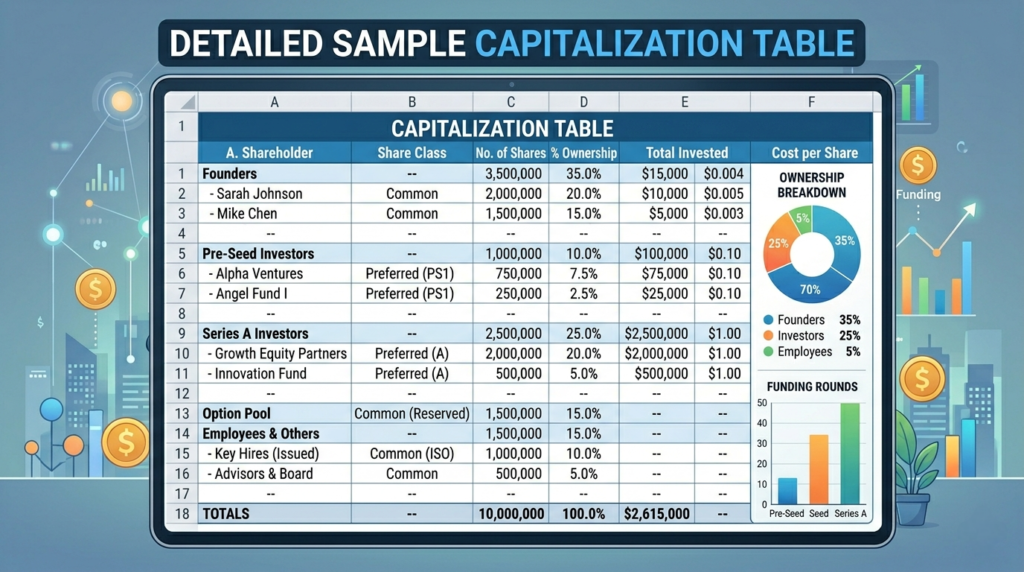
You use this document to record the name of every individual or company that owns a portion of your business. It acts as the official, chronological record for everyone from the original founders to the newest employees who receive stock options.
By keeping this ledger accurate, you ensure there is no confusion about who has a legal claim to the company’s assets or future profits. It serves as the single source of truth for your ownership data and helps you manage shareholder meetings with confidence.
Total Shares Outstanding
You use the cap table to calculate the total number of shares the company has issued to date. This number includes the common stock held by you and your founders, the preferred stock held by your investors, and the shares currently held in your employee option pool.
Having a complete count of all these shares allows you to understand the total equity structure of the business at any moment. It gives you the necessary data to report your company’s size to regulators or potential buyers and prevents you from over-issuing shares.
Percentage of Ownership
It breaks down the exact percentage of the company each person owns based on their individual share count. You calculate this by taking a person’s shares and dividing them by the total shares outstanding at that specific time.
This percentage is critical because it determines who has the most influence in shareholder votes and who maintains the most control over the company’s long-term direction. It also dictates the specific amount of money each person receives if the company is eventually sold or liquidated.
Value Tracking
It records the specific price paid for shares during every separate funding round your company completes. This historical data helps you determine the current market value of each stakeholder’s position based on the most recent valuation.
By tracking these values, you can see how much the worth of your own shares has grown since you first started the business. It allows you to provide your investors with an accurate update on the financial performance of their holdings and helps you plan for future exit strategies.
Dilution Visual
It shows how the arrival of new investments changes the ownership percentages of your existing shareholders. When you issue new shares to raise capital, the total number of shares increases, which reduces the percentage held by everyone who was already on the cap table.
You use this visual representation to plan for future funding rounds and to see exactly how much your personal ownership stake will decrease as you bring in more outside money. This helps you manage the balance between raising capital and maintaining control of your vision.
For a visual walkthrough of how to build and maintain your first cap table, check out this YouTube video. Seeing the spreadsheet logic in action helps you avoid common formatting errors.
What is a Cap Table in Business and Private Equity?
As a company grows beyond its initial stages, the complexity of its ownership increases. You must understand what is a cap table in business to manage corporate governance, and what is a cap table in private equity to handle sophisticated investment rounds.
Corporate Governance
In a standard business, you use this record to track voting rights. This ensures that only the individuals with the legal right to vote participate in major company decisions. It also allows you to calculate and distribute dividends correctly among all shareholders based on their current ownership percentage.
Investment Due Diligence
In private equity, professional investors use the cap table to perform deep due diligence. They specifically analyze the “liquidation preference,” which determines the order of who gets paid first when the company is sold. This helps investors calculate their potential returns and evaluate the risk of their investment.
Strategic Decision Making
Business leaders use this data to understand the long-term impact of their choices. You look at the cap table to see how issuing new debt or equity will affect the company’s financial health. It helps you decide if taking on a new partner or investor is beneficial for the existing shareholders.
Historical Record
The document serves as a complete legal history of every transaction involving your company’s stock. You need this accurate history to remain in compliance with government regulations. It provides the necessary evidence for audits and ensures that all share transfers follow the correct legal procedures.
What is a Cap Table for a Startup?
For a founder, the most critical application of this data happens in the early stages of growth. You must understand what is cap table for a startup to manage your relationships with early backers and your core team effectively.
Fundraising Preparation
You present this document to Angel Investors and Venture Capitalists during the due diligence process. They examine it to see exactly who they are sharing the company with and to ensure no “dead equity” exists. An organized record proves to potential investors that you manage your company’s finances and legal structure with professional care.
Employee Equity Management
You use the document to track your “Option Pool.” This is a specific block of shares you set aside to attract and reward your team. By recording these grants, you can accurately manage how your employees earn their ownership through Cliff Vesting and ensure you do not promise more shares than the company has available.
Scenario Modeling
The document allows you to run “what-if” scenarios for future growth. You use it to see exactly how much of the company you will own after a new round of funding or after hiring a senior executive. This modeling helps you make informed decisions about how much capital to raise and at what valuation, preventing unexpected loss of control.
Tax and Compliance
For a startup, an accurate record is a legal requirement for 409A valuations in the US or and Merchant Banker valuations under Rule 11UA in India. You must follow local tax laws regarding stock options to avoid heavy penalties for the company and your employees. It ensures that every share you issue meets the necessary regulatory standards.
Investor Relations
It keeps your early backers informed about their current stake and the status of their investment as the company grows. You use the data to provide regular updates on ownership changes, which maintains a positive relationship with your investors. This transparency is vital for building the trust needed to secure their support in future funding rounds.
Want to see how other founders handle complex equity splits? Read this Reddit thread where entrepreneurs share their real-world experiences with cap table management and investor negotiations.
What are the Key Components of an Accurate Cap Table
To be useful for legal and financial purposes, your record must include specific building blocks. You must track these five components to ensure your data remains reliable for auditors and future investors.
Founder Equity
This section lists the common stock held by the original creators of the business. You record the exact number of shares issued to each founder at the company’s inception. It is important to document the vesting terms for these shares to show how the founders earn their ownership over time.
Preferred vs. Common Stock
You must distinguish between the different classes of shares in your company. “Common Stock” is typically issued to founders and employees and usually carries basic voting rights. “Preferred Stock” is issued to investors and includes extra protections, such as the right to be paid first during a sale or liquidation of the company.
Convertible Notes and SAFEs
You include any debt instruments that will eventually turn into equity during a future funding round. These are not yet actual shares, but they represent a promise of future ownership. Recording these accurately ensures you understand your “fully diluted” ownership, which accounts for all potential shares that could be issued.
Stock Option Pool
This records the total number of shares you have reserved for future hires. You track the status of currently granted options versus those that are still available in the pool. Keeping this updated prevents you from over-promising equity to new employees and helps you manage your hiring budget effectively.
Stakeholder Contact Data
Every entry in your record must include the legal name and contact information of the shareholder. You use this data to send formal communications, such as voting notices or tax documents. Maintaining accurate contact details ensures you meet your legal obligations to every person who owns a stake in your business.
For more nuanced advice on Preferred stock and SAFEs, check out this Reddit thread. It provides insights into how professional investors view the different components of your cap table.
Conclusion
A capitalization table is the central source of truth for your company’s ownership and value. It serves as the official record that proves who owns which portion of your business. By maintaining an accurate document, you ensure that every stakeholder understands their position and that you stay in control of your company’s financial destiny.
You must update this record every time you issue a new share, hire a key employee, or receive an investment. Keeping your data current prevents legal disputes, simplifies your tax compliance, and builds the trust necessary to secure future funding. An organized cap table is a sign of a professional founder who is ready to scale a successful business.
To further your knowledge, you should explore the Startup Words. There, you will find more definitions of complex business terms that will help you through the journey from a promising idea to a market leader. Stay informed to make the best decisions for your company’s growth.
For any feedback or collaboration, feel free to contact us.
Frequently Asked Questions (FAQs)
Should I use a spreadsheet or specialized software to manage my cap table?
You can start with a simple spreadsheet when your company has only a few shareholders. However, as you hire more employees and take on multiple investors, manual tracking becomes difficult and prone to errors. You should switch to specialized cap table management software once you have more than ten stakeholders to ensure your data remains accurate and legally compliant.
How often should I share the full cap table with my employees?
You generally do not share the entire document with all employees. While transparency is important, the cap table contains sensitive financial data about every stakeholder. You should provide individual employees with a summary of their own specific grants, vesting schedules, and the total number of shares outstanding so they can calculate their own ownership percentage.
What is the difference between “Issued Shares” and “Fully Diluted Shares”?
“Issued Shares” refers only to the stock that people currently own. “Fully Diluted Shares” represents the total number of shares that would exist if everyone exercised their options and all convertible debt turned into equity. You must always look at the fully diluted number when calculating your actual ownership percentage, as this accounts for all future potential shares.
Can I fix an error on my cap table if I discover it months later?
Yes, you can fix errors, but it often requires legal assistance. You must issue corrective stock certificates or sign legal amendments to previous agreements. Because errors can impact tax filings and investor trust, you should perform a “cap table audit” with your legal counsel before every new funding round to catch and resolve mistakes early.
How does a “Down Round” affect my cap table?
A “down round” happens when you raise money at a lower valuation than your previous round. This causes significant dilution for existing shareholders and can trigger “anti-dilution” clauses for earlier investors. You use your cap table to model these impacts and understand how much additional equity you must give up to secure the new capital.